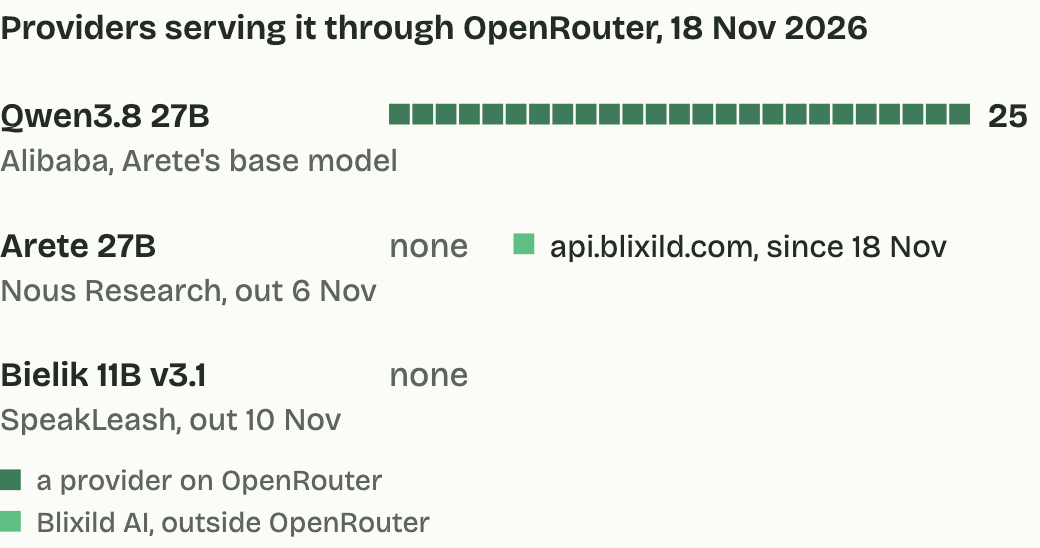
On 6 November 2026, Nous Research released Arete 27B, and within days people had made dozens of copies of it to run on their own graphics cards. Nobody offered the simplest way to try it: an API, an address on the internet that a program sends text to and gets an answer back from, paid by use. We looked and found none. Bielik 11B v3.1, the Polish model released four days later, was in the same position.
Since 18 November, Arete 27B answers through Blixild AI at api.blixild.com, from a single RTX 3090 in our spare previous-generation server in Poland. Getting there showed us why a model so easy to download is so hard to call, and what one graphics card can do about it. This post tells that story, for developers who want to try open models and for engineers who run them on their own cards.
A model everyone downloads and nobody serves
Arete is a fine-tune: Nous took Qwen3.8 27B, a strong open model from Alibaba, and trained it further to answer questions of values from what Nous calls Western values. On Nous's own test of 803 questions about freedom of expression, privacy, democracy and similar subjects, Arete states more of the verified facts than the model it came from. On Nous's test of general ability, it is as good as before.
The point reaches beyond one model. If a small amount of training can change a model's values, those values can be tested, compared and chosen, and Nous publishes the weights, the data and the test so that anyone can. For people who use a model to research, write or teach, that is a choice they did not have before.
The choice ends at the download, though. The popular Qwen3.8 27B can be called through 25 providers on OpenRouter, a service that brings many providers under one API. Arete had none when we checked on 18 November.
The GPU hour decides which models you can call
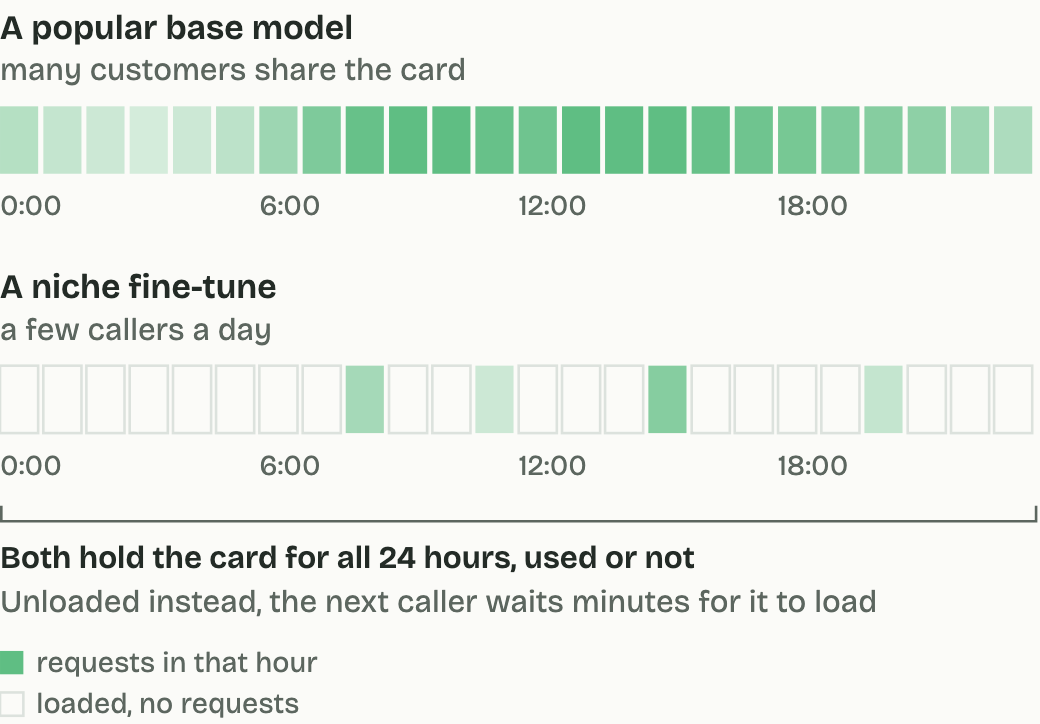
The reason is not the model but the hardware behind every API. A model answers only while it sits in the memory of a graphics card, or GPU, and it holds that memory whether anyone is asking or not. For a provider, every hour a model stays loaded is an hour of a GPU paid for.
A popular model fills those hours with many customers. A fine-tune like Arete, or a regional model like Bielik, has too few callers to fill them. The provider can keep it loaded and pay for idle hours, or unload it and make the next caller wait minutes while it loads again. Neither is good business, so providers host the models everyone already uses, and new ones wait.
What running Arete 27B yourself takes
The alternative is to run the model yourself, on a gaming card, a workstation card, a Mac with plenty of memory or a GPU rented by the hour. We chose an RTX 3090 that we had freed up in early November, when we moved another machine to a newer card. NVIDIA launched it in 2020 at $1,499 as its top gaming card, and its 24 GB of memory turned out to be just enough for a model of Arete's size, which made it a common choice for running models at home.
Its price shows how sought-after it has become. In autumn 2025, a used 3090 could be had for $600 to $900. In April 2026, the three cheapest listings on eBay averaged about $1,090, and by November used 3090s were listed in the U.S. at about $1,660 on average, more than the card cost new six years ago. Newer cards climbed with it: in Polish shops, an RTX 5090 that ships within a day costs about 35,000 to 45,000 zł with VAT, or $8,700 to $11,200, against a launch price of $1,999.
Whatever the hardware, it is only the start. The model has to be shrunk to fit, and there are dozens of shrunk versions to choose from. Then the software has to be tuned until the model and the conversations it holds fit in memory together.
Shrinking a model can cost some accuracy, and we have not yet measured how much for Arete.
One RTX 3090, a public API in a week
Our 3090 now has a server of its own and one job. Running a model on it is not yet a service, though. A service needs accounts and keys, a price on every token (the word pieces models read and write), and an address on the internet. The card's server has no public address and needs none. The public side, the API gateway and the portal, runs on a separate server in Helsinki, which looks after customer accounts and credit, and reaches the card over an encrypted link that opens one door and nothing else.
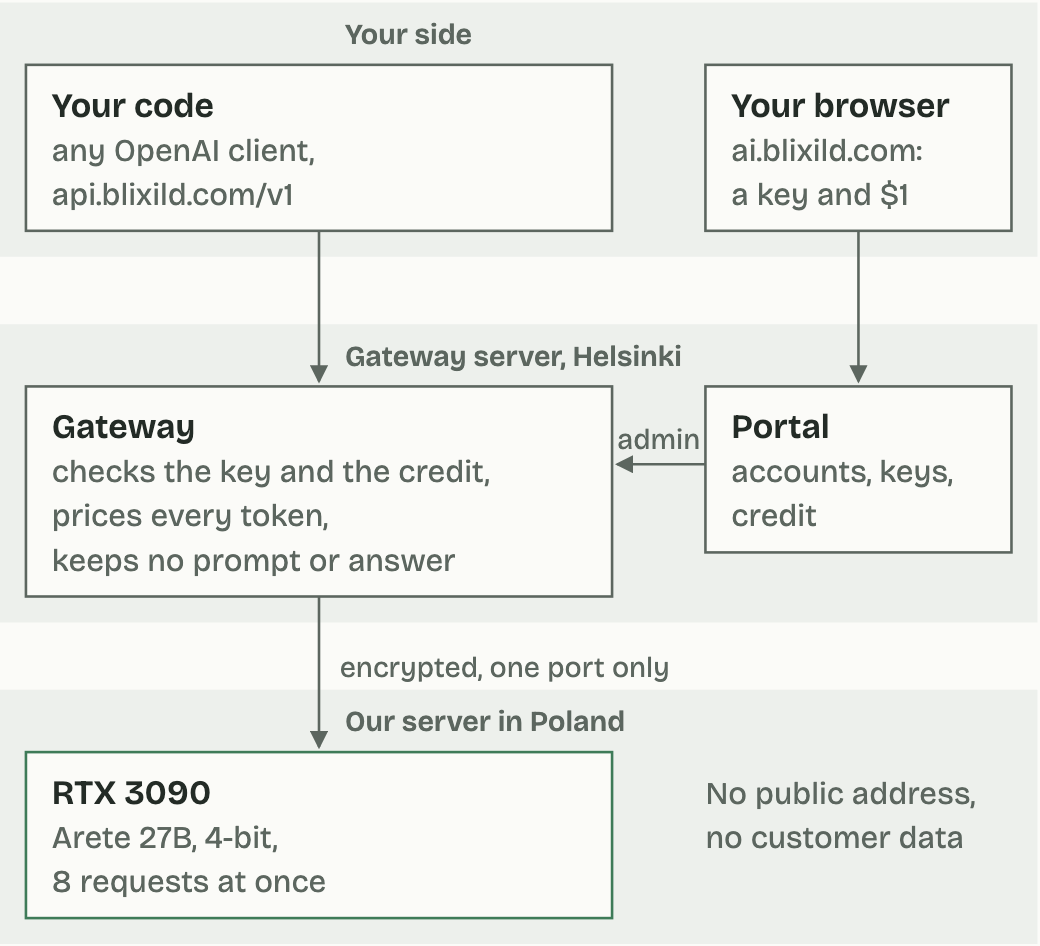
For a customer, that comes down to three things. Each model has its price per token on the front page, and you pay only for the tokens you use. Your credit cannot run over: when it reaches $0, requests stop, and no bill arrives later. And what you send is not kept: our records hold the time, the number of tokens and the cost, never the text, and all of it stays in the EU.
The service takes text only, and one card suits trying the model on your own work, building and testing an application, and everyday use at a modest scale. Large batch jobs need more than one card; for those, we set up dedicated hardware.
When niche models are one call away
When a model is one call away, trying it costs cents. You give it your own documents and your own hard cases, and you see quickly whether it deserves more of your time, before you buy a card or rent one by the hour. A model that people have so far only downloaded starts being used, and its makers gain users as well as downloads.
That is the part a small company with its own cards can play. The API is exploratory: we opened it to give the open-model community something it lacks, and we will scale it, with more cards and more models, if the demand is there. Our card is paid for and sits in our own server, so keeping a model loaded costs us electricity, not rent, and a model with few callers can wait for them. We measure each model on our cards before we offer it. Bielik ran on this same 3090 in October, and since 19 November Bielik 11B v3.1 answers through Blixild AI as well, from an RTX 5090.
Your first call
Sign in at ai.blixild.com with Google or GitHub. Your key is ready with $1 of credit and no card needed, and the dashboard gives you a first call with the key already in it. Any OpenAI client library works with api.blixild.com/v1.
curl https://api.blixild.com/v1/chat/completions \
  -H "Authorization: Bearer $BLIXILD_API_KEY" \
  -H "Content-Type: application/json" \
  -d '{"model": "arete-27b", "messages": [{"role": "user", "content": "Hello!"}]}'
Arete on Blixild AI also handles tool calls in the OpenAI format: the model asks the program calling it to use a tool, such as a search or a command in a terminal, and then works on with the result. Agents work this way, among them Hermes Agent, Nous Research's open-source agent, with more than 260,000 stars on GitHub. It remembers its user's projects, writes reusable skills as it works and runs tasks on a schedule, from a terminal or from chat apps such as Telegram and Slack, on whichever model its user picks, and it accepts any OpenAI-compatible address like this one.
Which other open models would you like to see here? Write to contact@blixild.com with the model and what you would use it for. Those requests decide what we add next.
If you need a model on your own premises or in your own cloud account, our AI workload hosting sets it up and runs it for you.
Sources
- Nous Research (2026). Introducing Arete-27B: Qwen3.8-27B Post-Trained To Reinforce Western Values. https://nousresearch.com/arete
- Nous Research (2026). Arete-27B, model card. https://huggingface.co/NousResearch/Arete-27B
- Bielik.ai (2026). Premiera modeli Bielik 11B v3.1, DFlash i rodziny Bielik-One. https://www.bielik.ai/blog/premiera-modeli-bielik-11b-v31-dflash-i-rodziny-bielik-one
- OpenRouter (2026). Models API and the endpoints of Qwen3.8 27B, read on 18 November 2026. https://openrouter.ai/api/v1/models
- Hugging Face (2026). Inference Endpoints, pricing. https://huggingface.co/docs/inference-endpoints/pricing
- Replicate (2026). Run a model. https://replicate.com/docs/topics/models/run-a-model
- NVIDIA (2020). NVIDIA Delivers Greatest-Ever Generational Leap in Performance with GeForce RTX 30 Series GPUs. https://nvidianews.nvidia.com/news/nvidia-delivers-greatest-ever-generational-leap-in-performance-with-geforce-rtx-30-series-gpus
- Hardware Corner (2026). RTX 3090 Local LLM Benchmarks, Context Scaling and Supported Models. https://www.hardware-corner.net/gpu-llm-benchmarks/rtx-3090/
- ResalePrices (2026). RTX 3090 Used GPU Price and Fair Asking Range, updated 18 November 2026. https://resaleprices.com/gpu/nvidia-rtx-3090
- Ceneo (2026). RTX 5090, karty graficzne: the offers of 28 models and their shipping times, read on 19 November 2026. https://www.ceneo.pl/Karty_graficzne;szukaj-rtx+5090
- GPU Poet (2026). NVIDIA GeForce RTX 3090 Price in April 2026. https://gpupoet.com/gpu/learn/price/april-2026/nvidia-geforce-rtx-3090
- GPU Poet (2026). October 2026 GPU Price/Performance Rankings. https://gpupoet.com/gpu/market-report/gpu-market-report-october-2026
- x-kom (2026). Search results for RTX 5090, with stock and delivery, read on 19 November 2026. https://www.x-kom.pl/szukaj?q=rtx%205090
- Narodowy Bank Polski (2026). Exchange rates, table 224/A/NBP/2026 of 18 November 2026. https://api.nbp.pl/api/exchangerates/rates/a/usd/2026-11-18/
- Hacker News (2025). 25L Portable NV-linked Dual 3090 LLM Rig, discussion of 19 to 24 September 2025. https://news.ycombinator.com/item?id=45300668
- Nous Research (2026). Hermes Agent, repository and README, read on 19 November 2026. https://github.com/NousResearch/hermes-agent
- bartowski (2026). NousResearch_Arete-27B-GGUF. https://huggingface.co/bartowski/NousResearch_Arete-27B-GGUF