Ternary Bonsai 2.5 27B stores each of its 27 billion weights in 1.76 bits. Its file is 6.2 GB, and the weights take 5.5 GiB of a graphics card's memory. That makes it look like a model for an 8 GB card. At its full context of 262,144 tokens, though, llama.cpp took 26.2 GiB of our H200. Most of that memory is a cache of what the model reads, and llama.cpp sets it aside for the whole context at start-up. Size the card for the context you need, not for the file.
This guide shows where the memory goes, measured on one H200 NVL: four context lengths, the cache at 16, 8, and 4 bits, and one to eight requests at once. It also covers how to build and serve the model with llama.cpp, how fast it runs, and how it did against Qwen3.8-27B FP8 on AppWorld's agent tasks. The take-aways:
| Take-away | On one H200 |
|---|---|
| The cache, not the weights, decides the card | 5.5 GiB of weights; 26.2 GiB at 262,144 tokens, shared by four requests |
| Every token in the cache costs the same | 70 KiB a token at 16 bits, 40 at 8 bits, 24 at 4 bits |
| A smaller cache fits the full context in far less | 18.7 GiB at 8 bits, 14.7 GiB at 4 bits |
| Each request at once adds a little | 24.4 GiB for one request, 28.6 GiB for eight: about 0.6 GiB each |
| MTP, a layer that guesses tokens ahead, speeds up one request, not four at once | 204 tokens/s with it, 175 without; four at once 260 in all with it, 281 without |
| Against Qwen3.8-27B FP8, Qwen's 8-bit release of the model Bonsai was made from, it finished more AppWorld tasks at lower cost on our API, but far more slowly | 57 against 52 of 72 AppWorld tasks; a median 195 against 28 s and $0.049 against $0.075 a task |
We loaded the file we serve once for each setting, with our own llama.cpp flags, and read the memory of the model's process in nvidia-smi straight after. After a few hours of serving, the same setting showed about 0.15 GiB more. We worked out the cost per token and per request from those readings. The speeds come from a few hundred tokens of English and Polish on a quiet card. We have not measured whether a smaller cache changes the answers. Memory is in GiB, as nvidia-smi gives it; a card sold as 24 GB holds about 24 GiB.
Anyone choosing a GPU for Bonsai 2.5 gets the memory for their context and the settings that shrink it. Teams already running llama.cpp get the build and the flags. Teams choosing a model for agents see how many tasks it finished, how fast and at what cost against Qwen3.8-27B FP8.
Ternary Bonsai 2.5 27B runs on llama.cpp and needs 26 GiB at its full context
Ternary Bonsai 2.5 27B is PrismML's release of Qwen3.8-27B for agents, published on 24 November 2026. Every weight is -1, 0, or +1, with one scale for each group of 128. Its makers report it level with the original model on tool calling. It is released for llama.cpp and Apple's MLX only. The file recommended for NVIDIA cards, which we serve, needs PrismML's own fork of llama.cpp.
The weights are a fifth of it. Of the model's 64 layers, 16 use full attention, and the file we serve adds a multi-token prediction (MTP) layer, which guesses tokens ahead. Each of those 17 layers keeps 4 KiB of KV cache for every token at 16 bits, 68 KiB a token. Our readings between 32,768 and 262,144 tokens give 70 KiB a token, 17.5 GiB at the full context. The other 48 layers use linear attention, which keeps a fixed state for each request instead. With the 5.5 GiB of weights and llama.cpp's working buffers, the full context came to 26.2 GiB with four requests at once.
How much memory each context length takes
With four requests at once, the table gives the memory the model's process took on the card, in GiB. The cache is at llama.cpp's default of 16 bits, or quantized to 8 or 4 bits:
| Context | Cache at 16 bits | 8 bits (q8_0) | 4 bits (q4_0) |
|---|---|---|---|
| 32,768 tokens | 10.9 | 10.0 | 9.5 |
| 65,536 tokens | 13.1 | 11.2 | 10.2 |
| 131,072 tokens | 17.4 | 13.7 | 11.7 |
| 262,144 tokens | 26.2 | 18.7 | 14.7 |
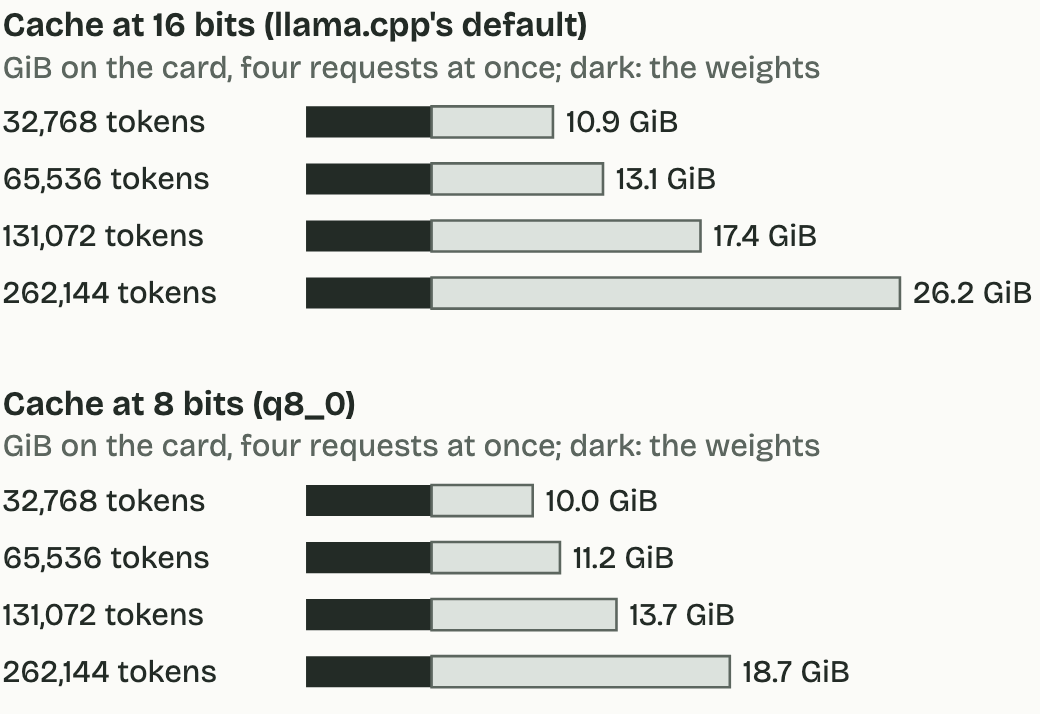
A smaller cache shrinks only the part that grows. The weights and buffers stay, about 8.7 GiB with four requests by our figures. At the full context, an 8-bit cache saves 7.5 GiB and a 4-bit one 11.5 GiB. With -kvu, llama.cpp shares one cache among the requests, so four requests at once split the 262,144 tokens rather than taking four times the memory. The full context took 24.4 GiB for one request and 28.6 GiB for eight, so each request adds about 0.6 GiB. All these figures are with the MTP layer. Without it, the full context took about 3.3 GiB less on our card (23.0 against 26.3 GiB, both read while serving).
On a 24 GB card, by these figures, one request at the full context needs about 16.9 GiB with an 8-bit cache, which fits. At 16 bits it needs 24.4 GiB, which is too much, but only about 21 GiB without the MTP layer, which fits. On an 8 GB card, the weights, the MTP layer, and one request's buffers take about 7 GiB. That leaves room for about 26,000 tokens at 8 bits or 44,000 at 4 bits, before the display takes its share.
How to build and serve it with llama.cpp
Build PrismML's fork with the library version its releases pin, or the MTP layer gains nothing. CCCL is NVIDIA's library of CUDA building blocks, and the fork's own release builds pin one version of it. Built from source without that version, the server dropped every guess the MTP layer made. Built with it, the server accepted about two guesses in five.
Our flags: -ngl 99 puts every layer on the GPU, -fa on turns on flash attention, -c 262144 sets the context, -np 4 -kvu serves four requests at once from one shared cache, and --jinja applies the model's chat template. Sampling is as PrismML recommends: --temp 1.0 --top-p 0.95 --top-k 20 --min-p 0, with min-p set to 0 by hand, as llama.cpp's default is 0.05. MTP takes --spec-type draft-mtp --spec-draft-n-min 0 --spec-draft-n-max 3 --spec-draft-p-min 0.1, as in the model card's preset. For an 8-bit cache, add -ctk q8_0 -ctv q8_0.
The model reasons at an effort of "xhigh" by default, and "medium" makes it reason less. Its makers say "low" behaves close to "xhigh", so it saves little, and "none" turns reasoning off. Its chat template answered "high" and "minimal" with an error, so our copy of it reads them as "xhigh" and "medium".
How fast it runs
MTP helps one request at a time. The layer guesses up to three tokens ahead for the model to check in one pass. On our card it raised one English request from 175 to 204 tokens a second and a Polish one from 176 to 181. With four requests at once, though, it cost more than it gained: 260 tokens a second in all against 281. Run it for one user at a time; for several at once, measure both. Qwen3.8-27B FP8 in vLLM, with its own MTP layer, wrote 189 tokens a second for one English request on the same card.
Against Qwen3.8-27B FP8 on AppWorld: tasks finished, time and cost
On AppWorld's challenge tasks, Bonsai finished a few more than Qwen3.8-27B FP8, at two-thirds of its cost a task at our prices, but each task took about seven times as long. AppWorld is a public benchmark in which an agent carries out everyday tasks in simulated apps by writing code against their APIs. We drew 200 of its 417 test_challenge tasks at random and ran Bonsai on them in the setup Qwen3.8-27B FP8 had run the night before. That setup is a ReAct loop with the apps' documentation and worked examples, reasoning off, and three tasks at a time, straight at each model's server on our H200.
Bonsai had MTP on and a 16-bit cache. Both servers also reused the part of each prompt they had already read, their prompt cache, which our API turns off for Bonsai. We stopped Bonsai after 88 tasks, when other requests reached the card and slowed it, and compare the 72 that started before then. A task counts as finished when all of AppWorld's checks pass: Bonsai finished 57 of the 72 and Qwen 52. With one run of each model, a gap of five tasks is small.
A task took Bonsai a median 195 seconds against Qwen's 28, and cost $0.049 at our prices against $0.075. All 72 tasks cost $3.97 on Bonsai and $6.80 on Qwen. On your own card the cost is the card's time instead, and Bonsai took about seven times as much of it.
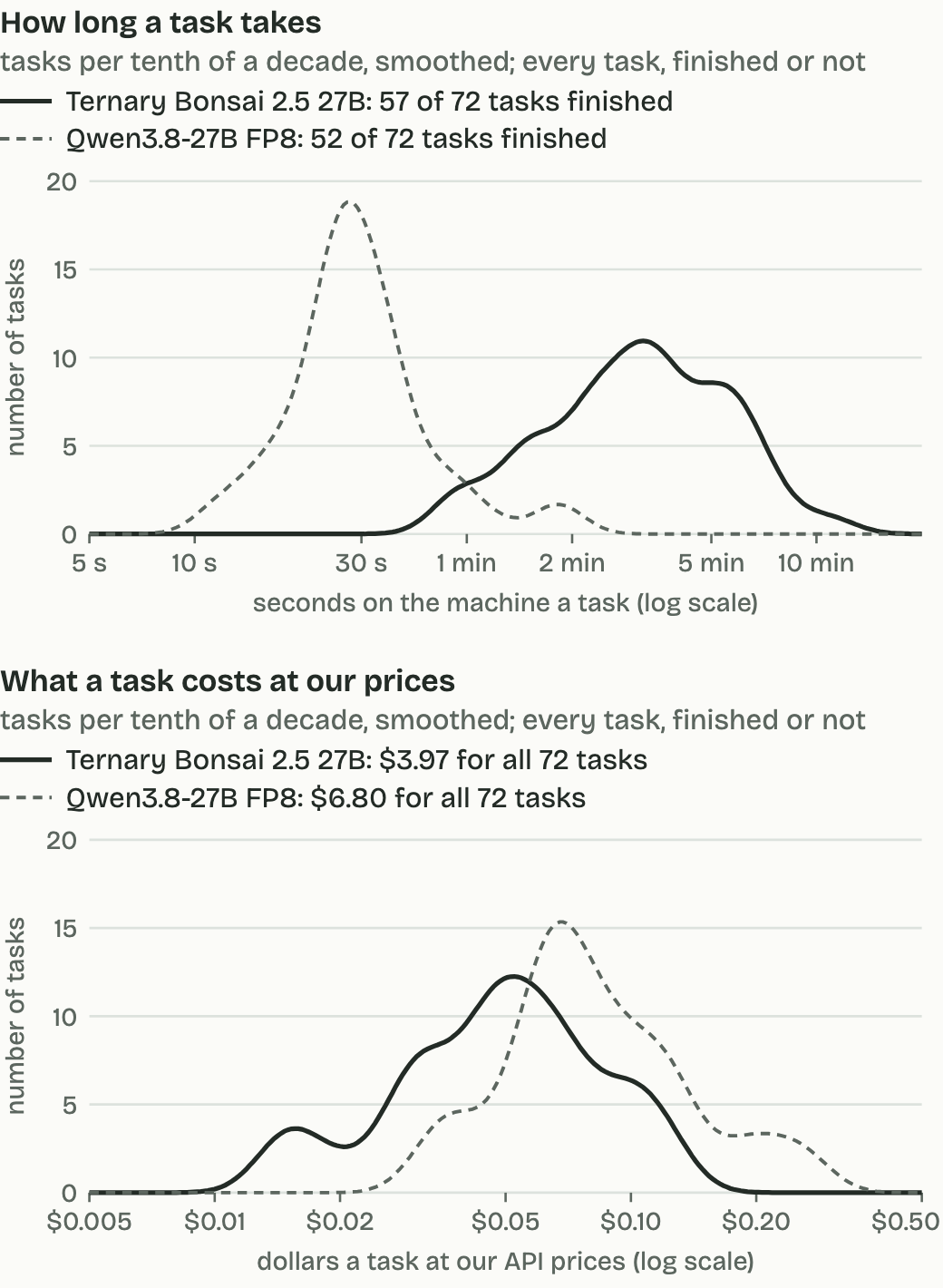
Most of the time goes into each call, not into extra steps. Bonsai made a median 29.5 model calls a task against Qwen's 24, but a call took it 6.8 seconds against Qwen's 1.1. Each task starts with about 20,000 to 29,000 tokens of documentation and examples, which Bonsai's server read in 13 to 27 seconds. With three tasks at a time and those long prompts, it then wrote about 40 to 55 tokens a second in each call, against 204 for one short request alone. Price is most of the cost gap: Bonsai's input costs half as much as Qwen's and its output a third. It also wrote more, a median 2,194 output tokens a task against 1,399.
How to size a card for it
- Start from the context you need. By our figures, one request takes about 7 GiB with the MTP layer, plus 70 KiB a token at 16 bits, 40 KiB at 8 bits, or 24 KiB at 4 bits. Each additional request at once adds about 0.6 GiB.
- Leave headroom for the display and anything else on the card.
- Try an 8-bit cache first if the full context does not fit, and check the answers you care about: we have not measured its effect on them.
- Build PrismML's fork with its pinned CCCL if you serve the file with the MTP layer, and check that the server's log shows guesses accepted (llama.cpp calls them drafts).
- Keep MTP for one request at a time, and measure with and without it if several run at once.
You know it fits when the model's process in nvidia-smi, once loaded, takes what your sum says. A request as long as your context should then answer without a memory error.
If you use Blixild AI, Ternary Bonsai 2.5 27B is on the API as ternary-bonsai-2.5-27b (its page). Sign in at ai.blixild.com, take the $1 of credit, and call it as any OpenAI-compatible model. Leave room in max_tokens for its reasoning, or it stops before the answer. Its reasoning_effort "high" counts as "xhigh" and "minimal" as "medium". Every request reads its whole prompt: llama.cpp cannot keep one customer's cached prompts apart from another's, so we turn its prompt cache off.
Terms
- KV cache
- What a model keeps of the text it has read in each conversation, so that it reads each token once. Its size sets how much conversation the card holds.
- Token
- A token is a word piece. Models read and write tokens, and API prices count them.
Sources
- PrismML, Ternary Bonsai 2.5 27B GGUF, model card and its CUDA preset
presets/llama.cpp/mtp-cuda.json(Hugging Face, revision 28a7093, read 25 Nov 2026). https://huggingface.co/prism-ml/Ternary-Bonsai-2.5-27B-GGUF