Bots now look for exposed API keys on ordinary websites by asking for the files in which apps and AI tools keep them. An AI key is worth finding, because whoever holds it can send requests that its owner pays for. A site that serves one of those files hands its key to anyone who asks, and checking that yours serves none takes a minute.
On 23 November one visitor asked the website of Blixild AI, our own AI API, for 214 such files in 3.7 seconds. The site holds none of these files, so each answers "not found". The scan shows three things:
- AI keys are on scanners' lists now. Thirty-one of the 214 files, about one in seven, belonged to AI tools.
- The old targets still lead, so one check covers both. Settings and .env files made up 70 requests, and cloud logins and build files 33 each.
- A "not found" answer means nothing was taken. The alarm is a file that comes back.
This is one scan of one site on one day. It shows what such scans ask for now, not how often they come or how many sites hand a file over. By September, AI tools' key and settings files were on a general list of credential files that scanners run from thousands of addresses. This scan was no one-off. HoneyLabs and Tin Analytics have followed such scans for weeks and describe them in more detail than this post does.
Developers and small teams who keep AI keys learn which files bots try and how to keep them out of reach. Whoever runs a company website and reads its logs learns to tell this knocking from a breach. Bots that borrow AI crawlers' names are in our post on which AI crawlers visit a company website.
What a scan for exposed API keys asks for
Such a scan reads no pages. It asks for the files a developer's computer or a server keeps beside the code, by their usual names, and waits to see which come back.
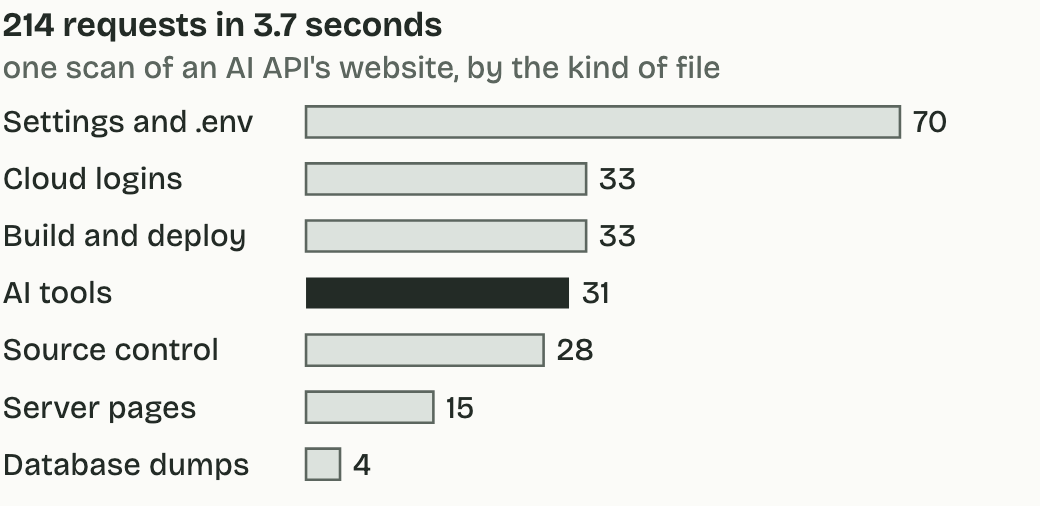
The largest group asked for .env files in 14 folders and for files called config, secrets or credentials. Others sought cloud tools' key files, build settings and the inside of a .git folder.
The 31 AI files are the new part. Six carry only the name of a provider such as OpenAI or Anthropic, for example /.env.openai, and the other 25 point to 14 AI tools. The llm command-line tool, for one, keeps the keys it is given in keys.json, which its documentation places on Linux at something like ~/.config/io.datasette.llm/keys.json. The scan asked for that same path, as it would appear if a web server published a user's home folder.
The 31 AI files the scan asked for
| Tool or provider | Files asked for |
|---|---|
| Claude Desktop | /claude_desktop_config.json, /.config/Claude/claude_desktop_config.json |
| Aider | /aider.conf.yml, /.aider.model.settings.yml |
| Continue | /.continue/config.json |
| Windsurf | /.windsurf/mcp_config.json |
| Zed | /.config/zed/settings.json |
| LLM | /.config/io.datasette.llm/keys.json, /.config/llm/keys.json, /.config/llm/credentials, /.llm/credentials |
| AIChat | /.config/aichat/config.yaml |
| ShellGPT | /.config/shell_gpt/.sgptrc |
| Mods | /.config/mods/mods.yml |
| Fabric | /.config/fabric/.env |
| Hugging Face | /.cache/huggingface/token, /.config/huggingface/token, /.huggingface/token |
| Gemini CLI | /.gemini/.env, /.config/gemini/settings.json |
| LiteLLM | /litellm.yaml, /litellm/config.yaml, /.litellm/config.yaml |
| AutoGen | /OAI_CONFIG_LIST, /oai_config_list.json |
| OpenAI and Anthropic | /.env.openai, /.env.anthropic, /.openai/credentials.json, /.config/openai/config.json, /.config/anthropic/config.json, /.config/claude/config.json |
The list shows what was asked for, not who asked or what a key would have been used for.
API key security in four steps
Files of AI tools now sit on the same lists as .env files, so one check covers both, and "not found" means nothing was taken. A key file reaches a website when the server publishes a home folder or a project's code with its hidden files. For developers and small teams, API key security for AI tools comes down to four steps:
- Check your site. Run the loop below against each domain you own. Every path should answer 404 (not found) or 403 (forbidden). Open any address that answers 200. Your home page there is harmless, because some sites answer every address that way, but the file itself is a leak.
- Keep keys out of anything a web server publishes, out of the code repository and out of code that runs in the browser. What a web server never holds, it cannot serve.
- Give each app its own key, and cap or prepay what it can spend. A leaked key can then be deleted without disrupting the other apps, and its spending stops at its limit.
- Replace leaked API keys first, because a leaked key keeps spending, then read what it was used for. If a file came back, every key in it counts as leaked.
site=https://example.com
for p in /.env /.git/config /.aws/credentials \
         /.env.openai /.env.anthropic /claude_desktop_config.json \
         /.config/llm/keys.json /OAI_CONFIG_LIST /.huggingface/token; do
  printf '%s %s\n' "$(curl -sL -o /dev/null -w '%{http_code}' "$site$p")" "$p"
done
In a site's logs, requests for these files answered with 404 are knocking, and a 200 is worth opening. One search finds any in an Apache or nginx log in its default format, and zgrep reads the compressed older logs too:
files='\.env|\.git/|\.aws/|claude_desktop_config\.json'
files="$files|\.config/llm/|OAI_CONFIG_LIST|\.huggingface/"
zgrep -E "\"GET /($files)[^\"]*\" 200 " access.log*
No line means none of these files was served while the logs were kept.
On Blixild AI, keys draw on prepaid credit, so a leaked key stops spending when the account's balance runs out. Each app can have its own key, which its owner creates and deletes in the dashboard.
Terms
- .env file
- A .env file lists an app's settings as NAME=value lines and keeps them apart from its code. Passwords and API keys are among the settings it is made for.
Sources
- Simon Willison, "Setup", LLM documentation, https://llm.datasette.io/en/stable/setup.html
- HoneyLabs, "We analyzed 366,845 requests from a scanner that asks web servers for .claude.json and .cursor/mcp.json", 11 November 2026, https://honeylabs.net/blog/mass-scanners-ai-assistant-configs
- Ege Demir, Tin Analytics, a write-up of three scanners that hunt AI keys on websites, 18 November 2026, https://tin.computer/blog/fake-ai-crawler-secrets-scanners