Blixild AI, our EU LLM API for open-source models, is open in beta. Five models answer from our own graphics cards in Poland, every request is processed only in the EU, and the service has zero data retention: we store neither what you send nor what the model answers. Prices run from $0.05 to $1.50 per million tokens. Sign in with Google or GitHub, and an API key with $1 of credit is ready, with no payment card.
It is for developers and companies that want an open model in their programs without running a GPU server, with texts that should stay in the EU. Below are the models, what happens to your text, how you pay, what the beta label means and the first call. Three of the models have posts of their own, on Bielik 11B v3.1, basal and Arete 27B, and so does how the service is built.
Five open-source models, from long documents to yes-or-no decisions
Three of the models write text and support tool calling, which agents are built on, and two only decide. None of them takes images or sound.
| Model | What it is for | Price per million tokens, input / output |
|---|---|---|
| qwen3.8-27b | Questions over long documents or many files at once, analysis, code, agents | $0.20 / $1.50 |
| arete-27b | Drafting, summaries, code and agents, at half Qwen's input price | $0.10 / $1.50 |
| bielik-11b-v3.1 | Polish text and chat, Polish documents without personal data | $0.20 / $0.50 |
| basal-2.0-4.5b | Decisions about a text: yes or no, a choice, a score | $0.10 / not charged |
| basal-2.0-mini | High volumes of simple decisions, such as routing messages | $0.05 / not charged |
Qwen3.8 27B, from Alibaba's Qwen team, holds up to 262,144 tokens in one request and in our tests found facts anywhere in documents of up to 254,000 tokens. Arete 27B is the same model, further trained by Nous Research. Both reason before they answer, and the reasoning is charged as output. Bielik 11B v3.1, from SpeakLeash and ACK Cyfronet AGH, is made for Polish.
The two basal models answer typed questions about a text, such as which team should handle an email, with a probability for each option, and write nothing. They charge only for the text they read: at $0.10 per million tokens, a 500-token request, an email with its question, costs $0.00005.
Bielik's terms of use forbid processing any personal data with it, so texts with any personal data, even a name in an email, go to one of the other four models. Special categories of data, such as health data, and data on criminal convictions go to none of the five unless we have agreed it in writing.
Processed only in the EU, with zero data retention (ZDR)
Whichever model it is for, a request reaches our server in Finland over an encrypted connection, where its key and credit are checked, and goes on, encrypted again, to the model on our GPU servers in Poland. That path has zero data retention: nothing on it stores your text or the answer in a file, a log, a database or anywhere else on disk, even when a request fails, unless the law requires us to keep them. We do not train models on them either.
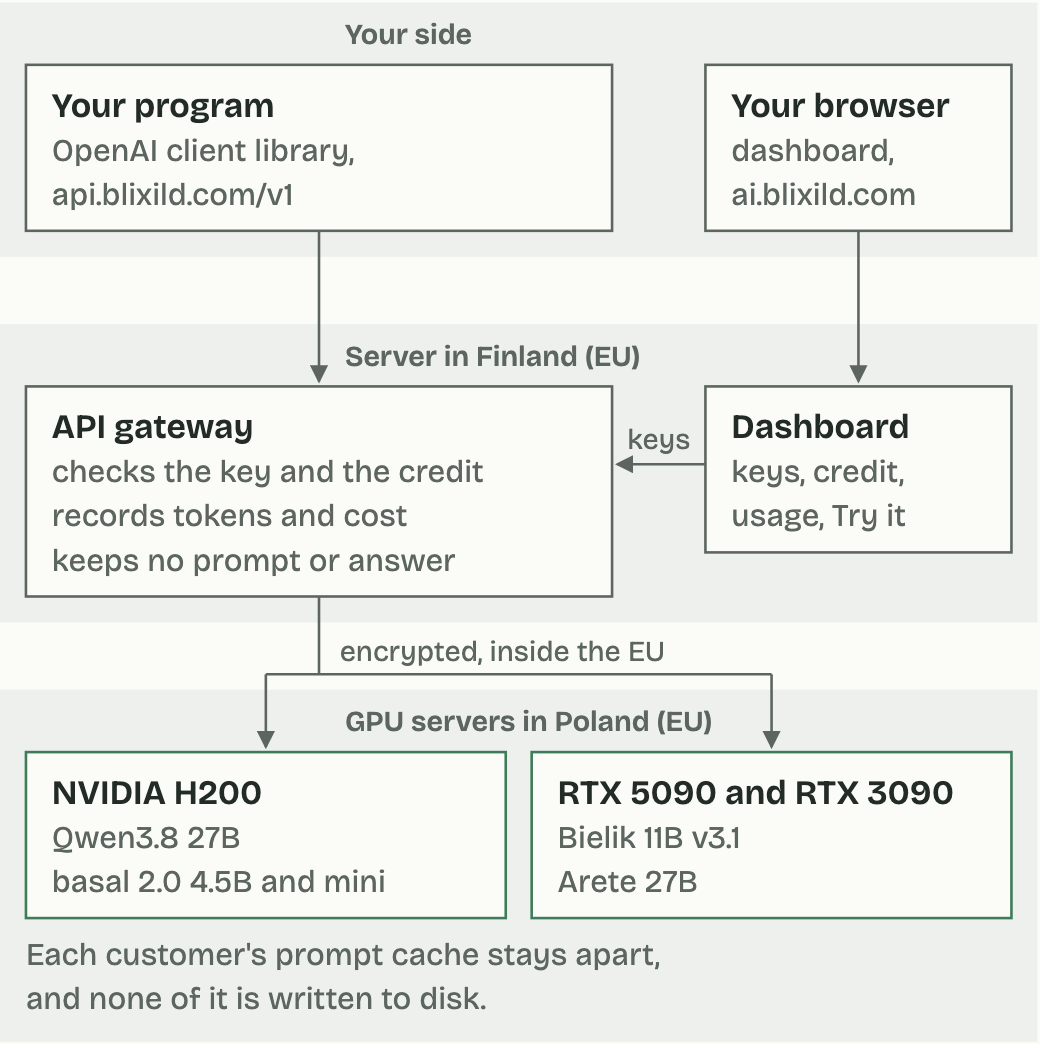
What we keep of each request is its usage record, the time, model, key, tokens and cost, for 12 months and longer only where tax law requires it, to charge your credit, show your usage and spot misuse. The graphics card keeps the work done on recent prompts in its memory, to answer a request that starts the same way sooner. That cache is kept apart for each customer and is never written to disk.
Where your texts contain other people's personal data, we process it for you as your processor under the GDPR. The data processing agreement that sets out how is part of our Terms of Service and has a page of its own. Business customers who need a signed copy or answers to a security questionnaire can write to us.
You remain the controller of the data you send: you need a legal basis to process it and must inform the people it concerns. Processing in the EU and the data processing agreement do not change that.
Prepaid credit, OpenAI-compatible calls and what the beta promises
Each request is charged to your credit at the model's price. Beyond the free $1, you add $5 to $500 at a time by card, Apple Pay or Google Pay, sold through Stripe's Link, with VAT included where it applies. When the credit reaches $0, requests stop and no bill arrives later, and unused credit can be refunded within 14 days of buying it.
The chat models follow OpenAI's API, so any OpenAI client library works once you give it the base URL api.blixild.com/v1 and your key; the basal models answer on routes of their own, /v1/systemone and /v1/decisions, with the same key. For the chat models, each key runs up to 2 requests at once and all your keys together up to 4. The basal models have a share of their own beside that, up to 16 requests at once on one key or all together, and one basal request can ask several questions about the same text. For more, write to us.
In beta, we do not promise uninterrupted service: during an outage, requests return an error until it ends. We email customers before planned interruptions, before we retire a model they used in the last 30 days and at least 14 days before a price rise. For now, the service suits development, internal tools and work that can retry a request, more than a service that must answer at every moment.
Your first call
Trying a model takes three steps, and only the choice of model depends on your texts: Qwen for long documents, Arete for writing and code at a lower input price, Bielik for Polish texts without personal data and basal for many small decisions. The steps are these:
- Sign in at ai.blixild.com with Google or GitHub. Your API key and $1 of credit are on the dashboard.
- Under Try it, choose a model, write a message and press Run. The answer appears with its time, tokens and cost, charged to your credit.
- Press Copy for the same request with your key already in it, in curl, Python or JavaScript or as a prompt for an AI coding agent, and run it in your own terminal or project.
From a terminal, the request looks like this, with your key in place of $BLIXILD_API_KEY:
curl https://api.blixild.com/v1/chat/completions \
  -H "Authorization: Bearer $BLIXILD_API_KEY" \
  -H "Content-Type: application/json" \
  -d '{"model": "arete-27b",
       "messages": [{"role": "user", "content": "Hello!"}]}'
If your data must not leave your own premises at all, our AI workload hosting sets up an open model on your own hardware or in your own cloud account and runs it for you.
Terms
- Data processing agreement
- The contract Article 28 of the GDPR requires when a company handles personal data for a customer: only on the customer's instructions, and kept secure.
- LLM
- An LLM is a large language model, trained on large amounts of text. Most write their answers one token at a time.
- Token
- A token is a word piece. Models read and write tokens, and API prices count them.
- Tool calling
- A model asks the calling program to run a function, then continues with the result. Agents work this way.
Sources
- SpeakLeash Foundation (2025). Terms of Use, version 1.1 of 31 July 2025. https://www.bielik.ai/en/terms